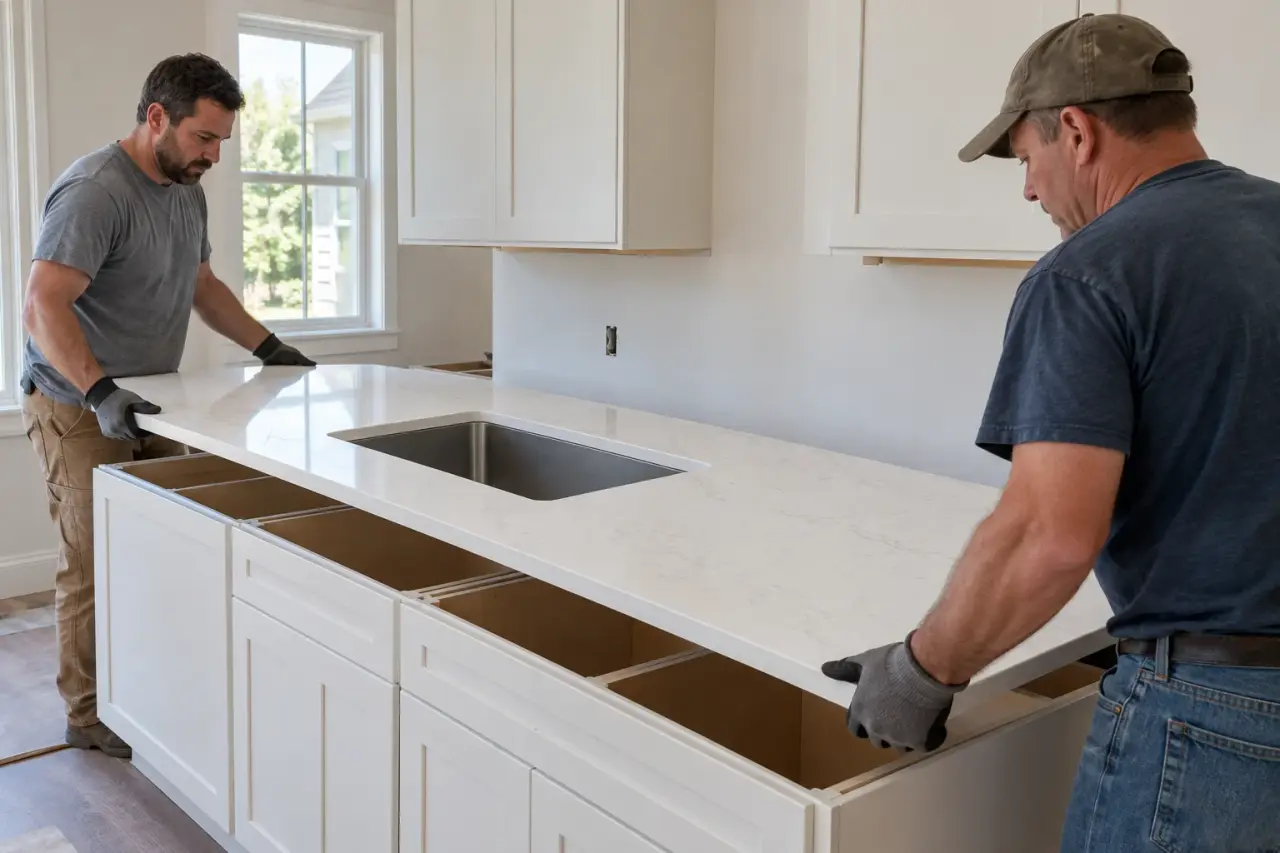
A new countertop is often the change that makes the biggest difference for the money, and it is a job with a fixed order. Stone and quartz tops are cut in a shop from a template of your cabinets, so the cabinets have to be in place and level before anyone can measure for the top.
How the job goes
- Choose the material. For stone, many shops ask you to see the actual slab, because two slabs of the same name can look different.
- Take out the old top. The sink and faucet are disconnected, and a tile backsplash usually comes off with the old top. Plan the new backsplash at the same time.
- Check the cabinets. The installer checks that the cabinet tops are level and solid enough for the new material.
- Template. The fabricator measures the cabinets with a physical or digital template, marking the sink, cooktop, faucet holes and overhangs.
- Fabrication. The top is cut and its edges finished in the shop, with the openings for the sink and cooktop.
- Installation. The top is set and seamed, an undermount sink is attached, and a plumber reconnects the sink and dishwasher.
- Backsplash. Tile goes on after the top is in, because it sits on the countertop.
Between the template and the installation the kitchen usually has no working sink. Ask the shop how long that gap is for your material.
Materials, in plain terms
- Quartz is engineered stone: crushed stone bound with resin, made in slabs.
- Granite, quartzite and marble are natural stone, cut from quarried slabs, each one different.
- Solid surface is a cast acrylic or polyester material that can be joined with nearly invisible seams.
- Laminate is a plastic surface on a board core, often cut and installed without a slab shop.
- Butcher block is wood, cut and finished on site or in a shop.
Ask the shop how each one handles heat, stains and cuts, and what it needs to keep looking right. Care rules differ between products, so the manufacturer's care sheet is the source to trust.
Ask how the shop cuts stone
Cutting and polishing engineered stone and many natural stones produces fine silica dust, which harms the lungs of the people who breathe it. California's workplace safety standard, updated in December 2024, requires wet methods for these tasks on engineered stone and bars dry cutting and dry sweeping. Whatever state you are in, it is fair to ask a fabricator whether they cut with water, and to keep any cutting on site to a minimum.
Licenses and permits
In Florida, cities and counties may not require a license for stone, granite or tile installation that includes no task the state licenses; reconnecting the plumbing is a separate matter. The City of Las Vegas lists countertops among the work that needs no building permit, as long as nothing else changes. Moving the sink or cooktop is plumbing, gas or electrical work, and that usually does need one; see Permits.
Updated 2026-10-12.